
oh-story-claudecode
An all-in-one AI skill collection covering the full workflow of long and short-form web fiction, including trend scanning, story disassembly, writing, AI flavor removal and cover generation

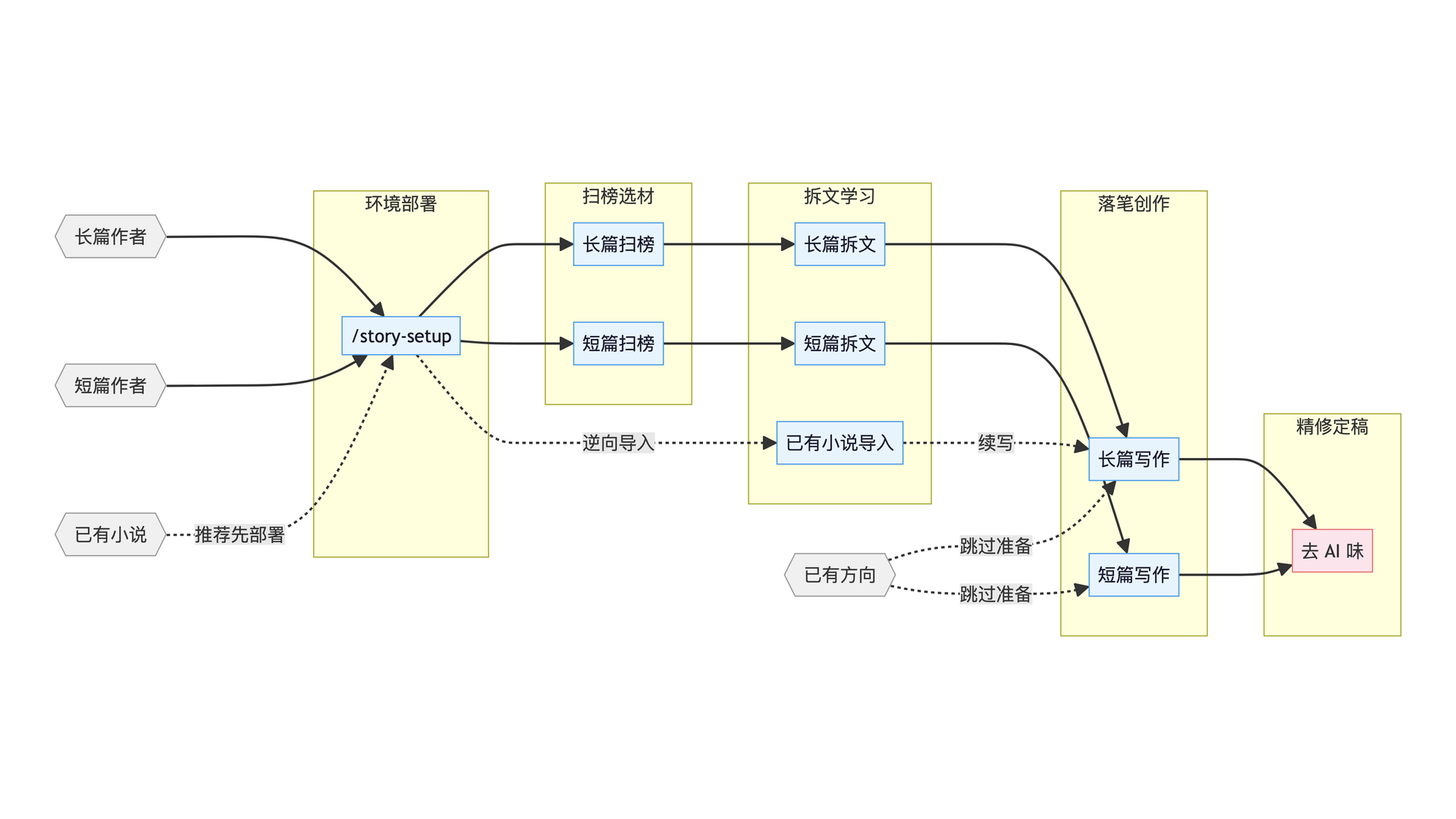
Suggested prompts
About this skill
oh-story-claudecode
A web-fiction writing skill pack covering the full pipeline for long-form and short-form online fiction: chart scanning, story deconstruction, writing, de-AI polishing and cover images. It ships with adapters for Claude Code, Google Antigravity, OpenCode, ZCode, OpenClaw, Codex CLI and Reasonix; Web AI / agent environments that can read project files can use it through the generic skills path.
Core Approach
Formula = deterministic emotional payoff
A professional author's three-step method:
- Scan the charts: analyse trending rankings to understand genre, character type and entry angle.
- Deconstruct stories: break down outline pacing and plot material to build a personal module library.
- Commercial writing: learn and apply hooks, satisfaction and anticipation.
Four working principles run through it: reverse-engineering hits, modular plot recombination, layered context-state management, and human-AI collaboration.
Preview
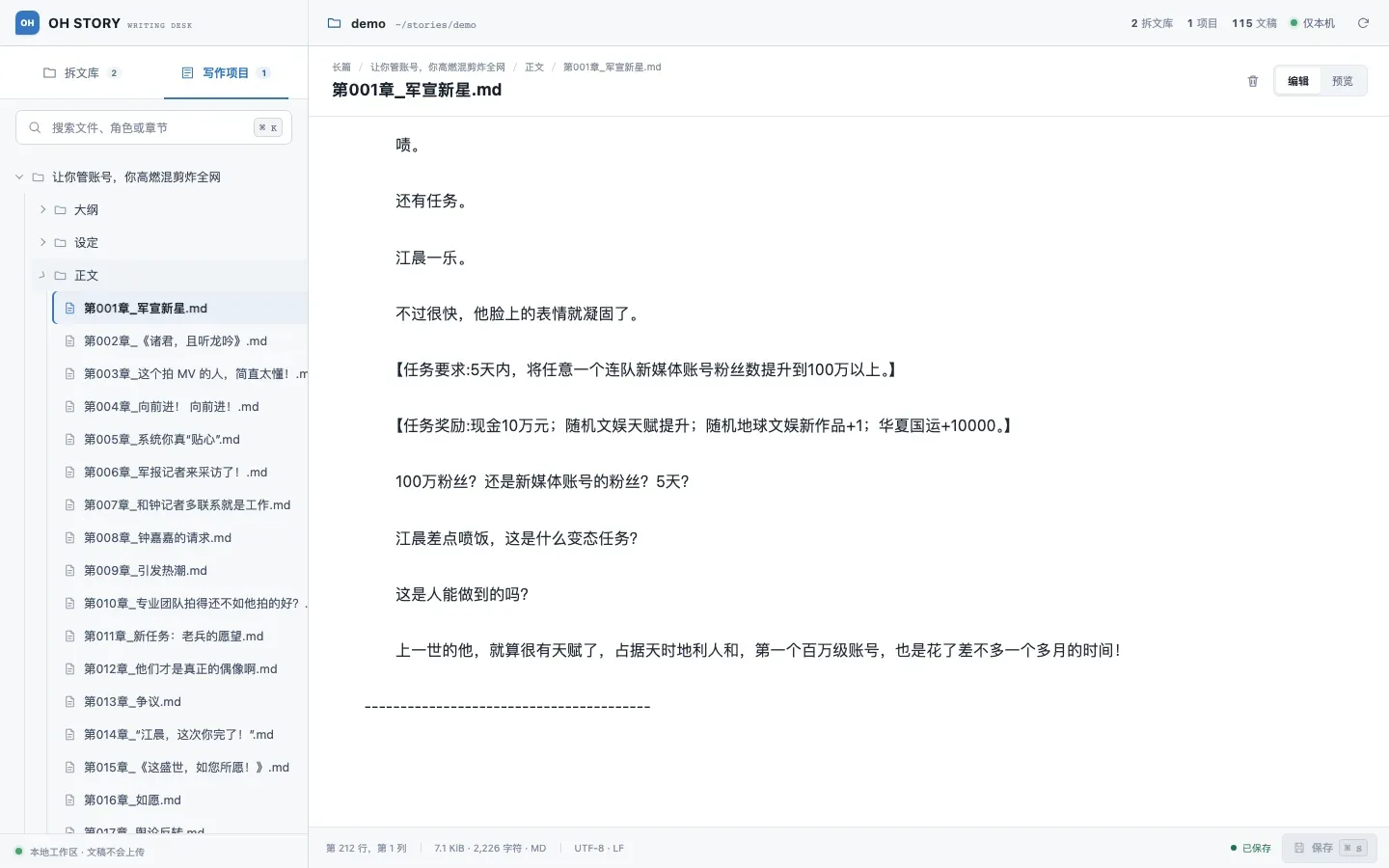
A local writing workspace for browsing your deconstruction library and long/short-form project trees, with search, Markdown preview, text editing, conflict-safe saving and confirmed deletion:
Cover generation example:

Core Capabilities
| Skill | Trigger | Description |
|---|---|---|
story-setup |
/story-setup |
Environment deployment for multiple CLIs and the generic path, safely merging existing configuration |
story |
/story /story dashboard |
Toolbox router: intent routing, author-habit management, local deconstruction/project dashboard |
story-long-write |
/story-long-write |
Long-form writing: outline building, character design, prose output |
story-long-analyze |
/story-long-analyze |
Long-form deconstruction: golden first three chapters, payoff design, pacing analysis |
story-long-scan |
/story-long-scan |
Long-form chart scanning: market trends across Qidian, Fanqie and Jinjiang |
story-short-write |
/story-short-write |
Short-form writing: emotion design, twist construction, final polish |
story-short-analyze |
/story-short-analyze |
Short-form deconstruction: story core, structure, emotional line, twists, technique, resonance |
story-short-scan |
/story-short-scan |
Short-form chart scanning: Zhihu Yanyan and Fanqie short-fiction trends |
story-deslop |
/story-deslop |
De-AI polishing: detect and remove AI writing traces |
story-import |
/story-import |
Reverse import: parse an existing novel into the standard project structure |
story-review |
/story-review |
Multi-perspective review with four reviewing agents plus platform scoring criteria |
story-cover |
/story-cover |
Cover generation: title and genre analysis plus an image model |
browser-cdp |
/browser-cdp |
Browser control: reuse logged-in sessions over CDP to collect data |
It also triggers on natural language:
- "Help me start a book" →
story-long-write - "This reads too AI" →
story-deslop - "Import my book" →
story-import - "Open the workspace" →
story dashboard - "Remember my writing habits" → author memory (quoted evidence, pending items, conflict replacement)
- "What state is Shen Zhi in?" → automatic character-state query
How It Works
environment setup → chart scanning → story deconstruction → writing → de-AI polish
- Environment setup: deploys skills, agents, rules and hooks into the writing project; existing configuration is merged safely and no global directory is required.
- Scanning and deconstruction: confirm genre, character type and entry angle from the charts, then break reference works into reusable structured material (characters, plot, setting, style, pacing, emotional modules).
- Writing: long-form work follows outlines, character designs and tracking state; short-form work follows emotion design and twist construction. Missing the corresponding detailed outline blocks first-time prose creation, forcing an outline first.
- Polish: detects and removes AI writing traces.
- Import and continue: an existing novel can be reconstructed into a standard writing project and continued from the next chapter.
Author habits carry across sessions: telling /story to remember your writing habits stores stable preferences in the workspace author-memory directory, and only an Author Memory Receipt confirms the write succeeded. During writing, only the confirmed items relevant to the current chapter are queried, and the full profile is never pushed into the prose prompt. Author memory is kept separate from per-book plot tracking, and current requirements, book settings and hard gates always take priority.
Long-Form or Short-Form
- Long-form:
/story-long-scan(chart scanning) →/story-long-analyze(deconstruction) →/story-long-write(writing, with master outline, volume outlines, chapter outlines and prose). - Short-form:
/story-short-scan→/story-short-analyze→/story-short-write.
Both tracks share /story-setup, /story-deslop, /story-review and /story-cover. To continue an existing novel, use /story-import.
What You Provide
- A writing direction or an existing novel: a genre direction alone works, or you can ask for chart scanning first, or for a specific reference work to be deconstructed
- Platform and genre preferences: long-form for Qidian, Fanqie, Jinjiang, Qimao and Ciwimao; short-form for Zhihu Yanyan, Fanqie short fiction and Qimao short fiction
- Creative parameters: for short fiction the total word count follows the range you give; long-form work advances chapter by chapter from a detailed outline
- A deployment environment: hooks depend on
nodebeing on the PATH
What You Get
- Long-form deconstruction: summary, deconstruction report, style analysis, chapter breakdowns and summaries, character files and relationships, plot lines and pacing, emotional modules, worldbuilding and faction setting
- Short-form deconstruction: deconstruction report (story core, five-dimension scoring, payoff analysis, cognitive twist, resonance analysis), plot nodes, writing techniques
- Long-form writing project: setting, outlines (master/volume/chapter), prose, reference material, tracking state (context, foreshadowing, character state, timeline)
- Short-form writing: finished draft and section outline
- Continuation project: published chapters reconstructed into a writable project structure, with per-chapter events, characters, settings, foreshadowing and timeline extracted
- Cover images: generated from title and genre
- Local writing workspace: the service only listens on
127.0.0.1, and novel content is not uploaded
Usage Examples
Long-form deconstruction (deep mode over the first 23 chapters of Panlong) produces: a book summary with chapter index, a deconstruction report with scoring and payoff density, style analysis at sentence and punctuation level, per-chapter deep analysis of the golden first three chapters, one file per character plus a relationship network, story lines and pacing, emotional modules, and worldbuilding split by topic.
Short-form deconstruction (an ~8,500-word story) produces: the original text backup, a deconstruction report with story core and five-dimension scoring, plot nodes quoted from the source with emotion values, and a list of writing techniques.
Import and continue: an author's first 20 published chapters (~37,000 words) are reconstructed into a writing project, ready to continue from chapter 21.
Supported Platforms
Long-form Qidian · Fanqie · Jinjiang · Qimao · Ciwimao
Short-form Zhihu Yanyan · Fanqie short fiction · Qimao short fiction
Notes
- No GPU and no self-hosted model are required: it runs inside the coding agent you already use, the writing model is that agent's model, and only deterministic check scripts (Node / Python) run locally. The exception is
story-cover, which calls an image model. - After deploying into a given CLI, a new session is usually required before the added agents and hooks take effect; after upgrading, re-run
/story-setupand start a new session. - The local de-AI check is a writing lint: blocking items are limited to deterministic sentence-pattern and punctuation problems, and the remaining hints are judged by reading feel. External detection tools serve only as a self-check reference, do not replace human judgement, and no pass of any AI detector is promised.
- Missing the corresponding detailed outline blocks first-time prose creation, forcing an outline first; after prose is written, a lightweight scan checks for truncation, engineering jargon, fixed patterns and word-count shortfall.
- Long-form prose uses a single machine-counted word count: every chapter outline must state a valid word target, and a missing target stops the run instead of falling back to a default; shortfalls are not padded and overruns are compressed at most once.
- Short-form writing no longer applies mechanical quotas such as per-section minimum length or dialogue ratio; each scene is judged by whether it changes risk, information, relationships, resources, decisions, actions or the reader's understanding.
- An existing novel can be imported: run
/story-setupin the writing project root, start or refresh the session, then run/story-importto parse it into the standard project structure before continuing chapter by chapter. - When the runtime does not expose custom subagents, skills that rely on specialist agents explicitly fall back to solo / direct execution.
- Skill copies generated inside a project stay in that project directory; re-running deployment does not clean them up automatically, and multi-level duplicate directories under the OpenClaw / Reasonix / generic paths must be removed by hand.
- The local workspace only listens on
127.0.0.1; content stays on your machine.